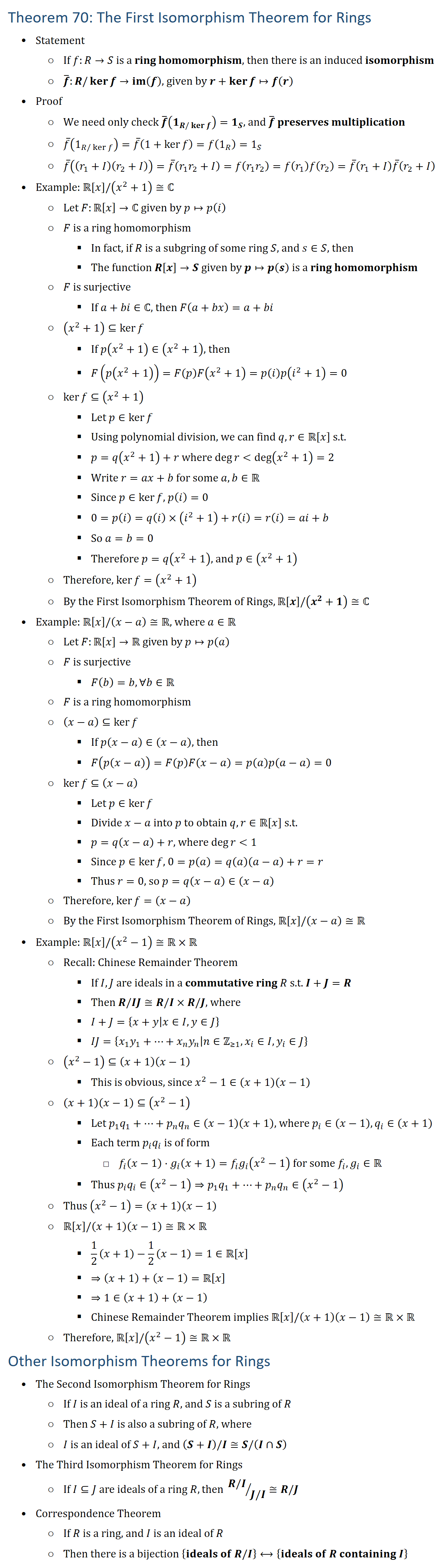
Theorem 70: The First Isomorphism Theorem for Rings • Statement ○ If f:R→S is a ring homomorphism, then there is an induced isomorphism ○ f ̅:R\kerf→im(f), given by r+kerf↦f(r) • Proof ○ We need only check f ̅(1_(R/kerf ) )=1_S, and f ̅ preserves multiplication ○ f ̅(1_(R/kerf ) )=f ̅(1+kerf )=f(1_R )=1_S ○ f ̅((r_1+I)(r_2+I))=f ̅(r_1 r_2+I)=f(r_1 r_2 )=f(r_1 )f(r_2 )=f ̅(r_1+I) f ̅(r_2+I) • Example: R[x]\(x^2+1)≅ℂ ○ Let F:R[x]→ℂ given by p↦p(i) ○ F is a ring homomorphism § In fact, if R is a subgring of some ring S, and s∈S, then § The function R[x]→S given by p↦p(s) is a ring homomorphism ○ F is surjective § If a+bi∈ℂ, then F(a+bx)=a+bi ○ (x^2+1)⊆kerf § If p(x2+1)∈(x2+1), then § F(p(x2+1))=F(p)F(x2+1)=p(i)p(i^2+1)=0 ○ kerf⊆(x^2+1) § Let p∈kerf § Using polynomial division, we can find q,r∈R[x] s.t. § p=q(x^2+1)+r where degr deg(x^2+1)=2 § Write r=ax+b for some a,b∈R § Since p∈kerf, p(i)=0 § 0=p(i)=q(i)×(i^2+1)+r(i)=r(i)=ai+b § So a=b=0 § Therefore p=q(x^2+1), and p∈(x^2+1) ○ Therefore, kerf=(x^2+1) ○ By the First Isomorphism Theorem of Rings, R[x]\(x^2+1)≅ℂ • Example: R[x]\(x−a)≅R, where a∈R ○ Let F:R[x]→R given by p↦p(a) ○ F is surjective § F(b)=b,∀b∈R ○ F is a ring homomorphism ○ (x−a)⊆kerf § If p(x−a)∈(x−a), then § F(p(x−a))=F(p)F(x−a)=p(a)p(a−a)=0 ○ kerf⊆(x−a) § Let p∈kerf § Divide x−a into p to obtain q,r∈R[x] s.t. § p=q(x−a)+r, where degr 1 § Since p∈kerf, 0=p(a)=q(a)(a−a)+r=r § Thus r=0, so p=q(x−a)∈(x−a) ○ Therefore, kerf=(x−a) ○ By the First Isomorphism Theorem of Rings, R[x]\(x−a)≅R • Example: R[x]\(x^2−1)≅R×R ○ Recall: Chinese Remainder Theorem § If I,J are ideals in a commutative ring R s.t. I+J=R § Then R\IJ≅R\I×R\J, where § I+J={x+y│x∈I,y∈J} § IJ={x_1 y_1+…+x_n y_n│n∈Z(≥1),x_i∈I,y_i∈J} ○ (x^2−1)⊆(x+1)(x−1) § This is obvious, since x^2−1∈(x+1)(x−1) ○ (x+1)(x−1)⊆(x^2−1) § Let p_1 q_1+…+p_n q_n∈(x−1)(x+1), where p_i∈(x−1),q_i∈(x+1) § Each term p_i q_i is of form □ f_i (x−1)⋅g_i (x+1)=f_i g_i (x^2−1) for some f_i,g_i∈R § Thus p_i q_i∈(x^2−1)⇒p_1 q_1+…+p_n q_n∈(x^2−1) ○ Thus (x^2−1)=(x+1)(x−1) ○ R[x]\(x+1)(x−1)≅R×R § 1/2 (x+1)−1/2 (x−1)=1∈R[x] § ⇒(x+1)+(x−1)=R[x] § ⇒1∈(x+1)+(x−1) § Chinese Remainder Theorem implies R[x]\(x+1)(x−1)≅R×R ○ Therefore, R[x]\(x^2−1)≅R×R Other Isomorphism Theorems for Rings • The Second Isomorphism Theorem for Rings ○ If I is an ideal of a ring R, and S is a subring of R ○ Then S+I is also a subring of R, where ○ I is an ideal of S+I, and (S+I)\I≅S\(I∩S) • The Third Isomorphism Theorem for Rings ○ If I⊆J are ideals of a ring R, then (R\I)⁄(J\I)≅R\J • Correspondence Theorem ○ If R is a ring, and I is an ideal of R ○ Then there is a bijection {ideals of R\I}⟷{ideals of R containing I}