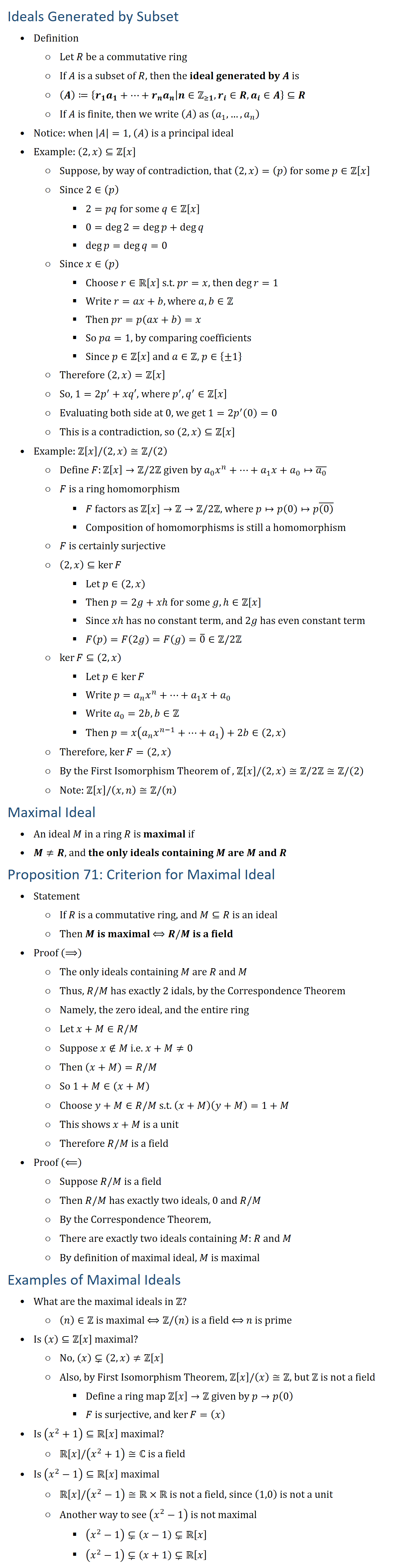
Ideals Generated by Subset • Definition ○ Let R be a commutative ring ○ If A is a subset of R, then the ideal generated by A is ○ (A)≔{r_1 a_1+…+r_n a_n│n∈Z(≥1),r_i∈R,a_i∈A}⊆R ○ If A is finite, then we write (A) as (a_1,…,a_n ) • Notice: when |A|=1, (A) is a principal ideal • Example: (2,x)⊆Z[x] ○ Suppose, by way of contradiction, that (2,x)=(p) for some p∈Z[x] ○ Since 2∈(p) § 2=pq for some q∈Z[x] § 0=deg2=degp+degq § degp=degq=0 ○ Since x∈(p) § Choose r∈R[x] s.t. pr=x, then deg〖r=1〗 § Write r=ax+b,where a,b∈Z § Then pr=p(ax+b)=x § So pa=1, by comparing coefficients § Since p∈Z[x] and a∈Z, p∈{±1} ○ Therefore (2,x)=Z[x] ○ So, 1=2p^′+xq′, where p′,q′∈Z[x] ○ Evaluating both side at 0, we get 1=2p^′ (0)=0 ○ This is a contradiction, so (2,x)⊆Z[x] • Example: Z[x]\(2,x)≅Z\(2) ○ Define F:Z[x]→Z\2Z given by a_0 x^n+…+a_1 x+a_0↦(a_0 ) ̅ ○ F is a ring homomorphism § F factors as Z[x]→Z→Z\2Z, where p↦p(0)↦p((0) ) ̅ § Composition of homomorphisms is still a homomorphism ○ F is certainly surjective ○ (2,x)⊆kerF § Let p∈(2,x) § Then p=2g+xh for some g,h∈Z[x] § Since xh has no constant term, and 2g has even constant term § F(p)=F(2g)=F(g)=0 ̅∈Z\2Z ○ kerF⊆(2,x) § Let p∈kerF § Write p=a_n x^n+…+a_1 x+a_0 § Write a_0=2b,b∈Z § Then p=x(a_n x^(n−1)+…+a_1 )+2b∈(2,x) ○ Therefore, kerF=(2,x) ○ By the First Isomorphism Theorem of , Z[x]\(2,x)≅Z\2Z≅Z\(2) ○ Note: Z[x]\(x,n)≅Z\(n) Maximal Ideal • An ideal M in a ring R is maximal if • M≠R, and the only ideals containing M are M and R Proposition 71: Criterion for Maximal Ideal • Statement ○ If R is a commutative ring, and M⊆R is an ideal ○ Then M is maximal ⟺R\M is a field • Proof (⟹) ○ The only ideals containing M are R and M ○ Thus, R\M has exactly 2 idals, by the Correspondence Theorem ○ Namely, the zero ideal, and the entire ring ○ Let x+M∈R\M ○ Suppose x∉M i.e. x+M≠0 ○ Then (x+M)=R\M ○ So 1+M∈(x+M) ○ Choose y+M∈R\M s.t. (x+M)(y+M)=1+M ○ This shows x+M is a unit ○ Therefore R\M is a field • Proof (⟸) ○ Suppose R\M is a field ○ Then R\M has exactly two ideals, 0 and R\M ○ By the Correspondence Theorem, ○ There are exactly two ideals containing M: R and M ○ By definition of maximal ideal, M is maximal Examples of Maximal Ideals • What are the maximal ideals in Z? ○ (n)∈Z is maximal ⟺Z\(n) is a field ⟺ n is prime • Is (x)⊆Z[x] maximal? ○ No, (x)⊊(2,x)≠Z[x] ○ Also, by First Isomorphism Theorem, Z[x]\(x)≅Z, but Z is not a field § Define a ring map Z[x]→Z given by p→p(0) § F is surjective, and kerF=(x) • Is (x^2+1)⊆R[x] maximal? ○ R[x]\(x^2+1)≅ℂ is a field • Is (x^2−1)⊆R[x] maximal ○ R[x]\(x^2−1)≅R×R is not a field, since (1,0) is not a unit ○ Another way to see (x^2−1) is not maximal § (x^2−1)⊊(x−1)⊊R[x] § (x^2−1)⊊(x+1)⊊R[x]