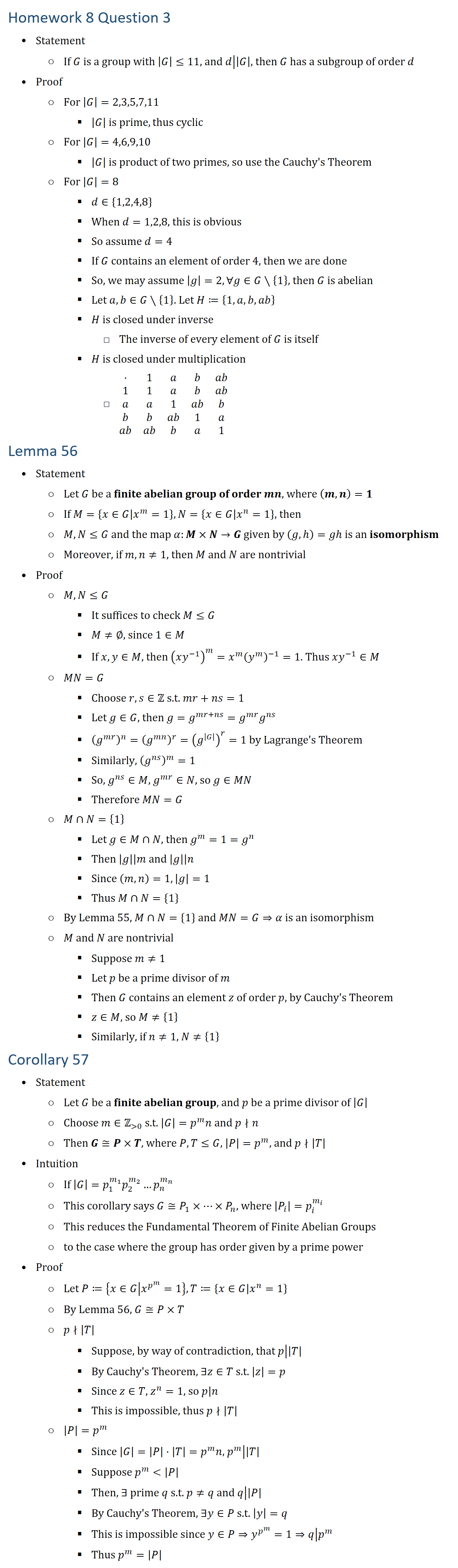
Homework 8 Question 3 • Statement ○ If G is a group with |G|≤11, and ├ d┤ ||G|┤, then G has a subgroup of order d • Proof ○ For |G|=2,3,5,7,11 § |G| is prime, thus cyclic ○ For |G|=4,6,9,10 § |G| is product of two primes, so use the Cauchy s Theorem ○ For |G|=8 § d∈{1,2,4,8} § When d=1,2,8, this is obvious § So assume d=4 § If G contains an element of order 4, then we are done § So, we may assume |g|=2,∀g∈G∖{1}, then G is abelian § Let a,b∈G∖{1}. Let H≔{1,a,b,ab} § H is closed under inverse □ The inverse of every element of G is itself § H is closed under multiplication □ ■8(⋅&1&a&b&ab@1&1&a&b&ab@a&a&1&ab&b@b&b&ab&1&a@ab&ab&b&a&1) Lemma 56 • Statement ○ Let G be a finite abelian group of order mn, where (m,n)=1 ○ If M={x∈G│x^m=1}, N={x∈G│x^n=1}, then ○ M,N≤G and the map α:M×N→G given by (g,h=gh is an isomorphism ○ Moreover, if m,n≠1, then M and N are nontrivial • Proof ○ M,N≤G § It suffices to check M≤G § M≠∅, since 1∈M § If x,y∈M, then (xy^(−1) )m=xm (y^m )^(−1)=1. Thus xy^(−1)∈M ○ MN=G § Choose r,s∈Z s.t. mr+ns=1 § Let g∈G, then g=g(mr+ns)=gmr g^ns § (g^mr )n=(gmn )r=(g|G| )^r=1 by Lagrange s Theorem § Similarly, (g^ns )^m=1 § So, g^ns∈M, g^mr∈N, so g∈MN § Therefore MN=G ○ M∩N={1} § Let g∈M∩N, then gm=1=gn § Then ├ |g|┤ |m┤ and ├ |g|┤ |n┤ § Since (m,n)=1,|g|=1 § Thus M∩N={1} ○ By Lemma 55, M∩N={1} and MN=G⇒α is an isomorphism ○ M and N are nontrivial § Suppose m≠1 § Let p be a prime divisor of m § Then G contains an element z of order p, by Cauchy s Theorem § z∈M, so M≠{1} § Similarly, if n≠1, N≠{1} Corollary 57 • Statement ○ Let G be a finite abelian group, and p be a prime divisor of |G| ○ Choose m∈Z( 0) s.t. |G|=p^m n and p∤n ○ Then G≅P×T, where P,T≤G, |P|=p^m, and p∤|T| • Intuition ○ If |G|=p_1^(m_1 ) p_2^(m_2 )…p_n^(m_n ) ○ This corollary says G≅P_1×…×P_n, where |P_i |=p_i^(m_i ) ○ This reduces the Fundamental Theorem of Finite Abelian Groups ○ to the case where the group has order given by a prime power • Proof ○ Let P≔{x∈G│x(pm )=1}, T≔{x∈G│x^n=1} ○ By Lemma 56, G≅P×T ○ p∤|T| § Suppose, by way of contradiction, that ├ p┤ ||T|┤ § By Cauchy s Theorem, ∃z∈T s.t. |z|=p § Since z∈T, z^n=1, so ├ p┤ |n┤ § This is impossible, thus p∤|T| ○ |P|=p^m § Since |G|=|P|⋅|T|=p^m n, ├ p^m ┤ ||T|┤ § Suppose p^m |P| § Then, ∃ prime q s.t. p≠q and ├ q┤ ||P|┤ § By Cauchy s Theorem, ∃y∈P s.t. |y|=q § This is impossible since y∈P⇒y(pm )=1⇒├ q┤ |p^m ┤ § Thus p^m=|P|