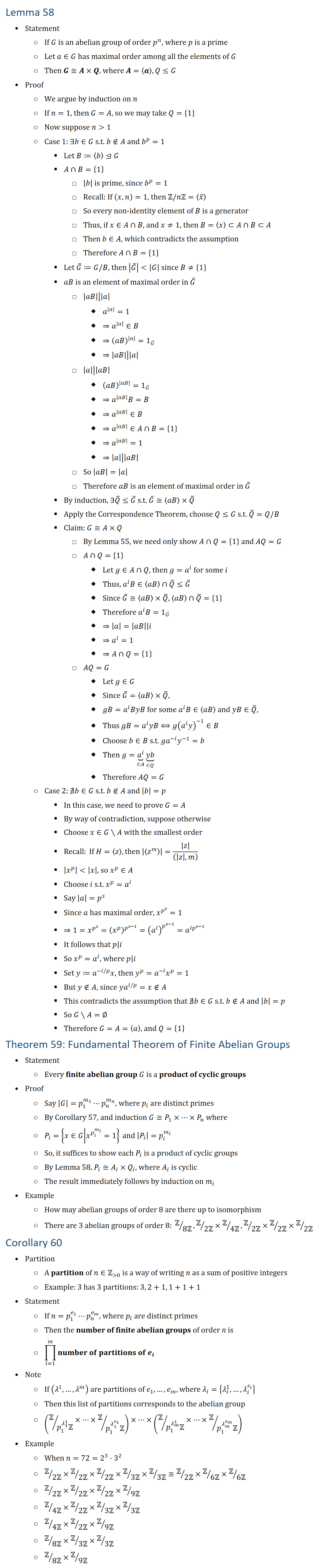
Lemma 58 • Statement ○ If G is an abelian group of order p^n, where p is a prime ○ Let a∈G has maximal order among all the elements of G ○ Then G≅A×Q, where A=⟨a⟩, Q≤G • Proof ○ We argue by induction on n ○ If n=1, then G=A, so we may take Q={1} ○ Now suppose n 1 ○ Case 1: ∃b∈G s.t. b∉A and b^p=1 § Let B≔⟨b⟩⊴G § A∩B={1} □ |b| is prime, since b^p=1 □ Recall: If (x,n)=1, then Z\nZ=⟨x ̅ ⟩ □ So every non-identity element of B is a generator □ Thus, if x∈A∩B, and x≠1, then B=⟨x⟩⊂A∩B⊂A □ Then b∈A, which contradicts the assumption □ Therefore A∩B={1} § Let G ̅≔G\B, then |G ̅ | |G| since B≠{1} § aB is an element of maximal order in G ̅ □ ├ |aB|┤ ||a|┤ ® a^|a| =1 ® ⇒a^|a| ∈B ® ⇒(aB)^|a| =1_G ̅ ® ⇒├ |aB|┤ ||a|┤ □ ├ |a|┤ ||aB|┤ ® (aB)^|aB| =1_G ̅ ® ⇒a^|aB| B=B ® ⇒a^|aB| ∈B ® ⇒a^|aB| ∈A∩B={1} ® ⇒a^|aB| =1 ® ⇒├ |a|┤ ||aB|┤ □ So |aB|=|a| □ Therefore aB is an element of maximal order in G ̅ § By induction, ∃Q ̅≤G ̅ s.t. G ̅≅⟨aB⟩×Q ̅ § Apply the Correspondence Theorem, choose Q≤G s.t. Q ̅=Q\B § Claim: G≅A×Q □ By Lemma 55, we need only show A∩Q={1} and AQ=G □ A∩Q={1} ® Let g∈A∩Q, then g=a^i for some i ® Thus, a^i B∈⟨aB⟩∩Q ̅≤G ̅ ® Since G ̅≅⟨aB⟩×Q ̅, ⟨aB⟩∩Q ̅={1} ® Therefore a^i B=1_G ̅ ® ⇒├ |a|=|aB|┤ |i┤ ® ⇒a^i=1 ® ⇒A∩Q={1} □ AQ=G ® Let g∈G ® Since G ̅=⟨aB⟩×Q ̅, ® gB=a^i ByB for some a^i B∈⟨aB⟩ and yB∈Q ̅, ® Thus gB=a^i yB⟺g(a^i y)^(−1)∈B ® Choose b∈B s.t. ga^(−i) y^(−1)=b ® Then g=⏟(a^i )┬(∈A) ⏟yb┬(∈Q) ® Therefore AQ=G ○ Case 2: ∄b∈G s.t. b∉A and |b|=p § In this case, we need to prove G=A § By way of contradiction, suppose otherwise § Choose x∈G∖A with the smallest order § Recall: If H=⟨z⟩,then |⟨z^m ⟩|=|z|/((|z|,m) ) § |x^p | |x|, so x^p∈A § Choose i s.t. xp=ai § Say |a|=p^s § Since a has maximal order, x(ps )=1 § ⇒1=x(ps )=(x^p )(p(s−1) )=(a^i )(p(s−1) )=a(ip(s−1) ) § It follows that ├ p┤ |i┤ § So xp=ai, where ├ p┤ |i┤ § Set y≔a^(−i\p) x, then yp=a(−i) x^p=1 § But y∉A, since ya^(i\p)=x∉A § This contradicts the assumption that ∄b∈G s.t. b∉A and |b|=p § So G∖A=∅ § Therefore G=A=⟨a⟩, and Q={1} Theorem 59: Fundamental Theorem of Finite Abelian Groups • Statement ○ Every finite abelian group G is a product of cyclic groups • Proof ○ Say |G|=p_1^(m_1 )⋯p_n^(m_n ), where p_i are distinct primes ○ By Corollary 57, and induction G≅P_1×…×P_n where ○ P_i={x∈G│x(p_i(m_i ) )=1} and |P_i |=p_i^(m_i ) ○ So, it suffices to show each P_i is a product of cyclic groups ○ By Lemma 58, P_i≅A_i×Q_i, where A_i is cyclic ○ The result immediately follows by induction on m_i • Example ○ How may abelian groups of order 8 are there up to isomorphism ○ There are 3 abelian groups of order 8: Z8ℤ, Z2ℤ×Z4ℤ, Z2ℤ×Z2ℤ×Z2ℤ Corollary 60 • Partition ○ A partition of n∈Z( 0) is a way of writing n as a sum of positive integers ○ Example: 3 has 3 partitions: 3, 2+1, 1+1+1 • Statement ○ If n=p_1^(e_1 )⋯p_n^(e_m ), where p_i are distinct primes ○ Then the number of finite abelian groups of order n is ○ ∏_(i=1)^m▒〖number of partitions of e_i 〗 • Note ○ If (λ1,…,λm ) are partitions of e_1,…,e_m, where λ_i={λ_i1,…,λ_i(s_i ) } ○ Then this list of partitions corresponds to the abelian group ○ (Z(p_1(λ_11 ) Z×…×Z(p_1(λ_1(s_1 ) ) Z)×…×(Z(p_1(λ_m1 ) Z×…×Z(p_1(λ_m(s_m ) ) Z) • Example ○ When n=72=23⋅32 ○ Z2ℤ×Z2ℤ×Z2ℤ×Z3ℤ×Z3ℤ≅Z2ℤ×Z6ℤ×Z6ℤ ○ Z2ℤ×Z2ℤ×Z2ℤ×Z9ℤ ○ Z4ℤ×Z2ℤ×Z3ℤ×Z3ℤ ○ Z4ℤ×Z2ℤ×Z9ℤ ○ Z8ℤ×Z3ℤ×Z3ℤ ○ Z8ℤ×Z9ℤ